Friday, February 11, 2011

Part 46: There and Back Again

"As all things come to an end, even this story, a day came at last when they were in sight of the country where Bilbo had been born and bred, where the shapes of the land and of the trees were as well known to him as his hands and toes."
-J.R.R. Tolkien


Back at Brent I stripped my bed and packed up the last of my things for storage. We didn't have to haul our trunks down to storage this year, as long as they were clearly labeled they would be moved for us. Then, after racing up to the dining hall for a quick bite to eat, Tommy Quinto drove us to the airport.

It was a long wait at Loakan airport, the flight was full and there was a lot of extra luggage, mostly from Brent students going home for the summer or back to the States. They were having difficulty getting all the luggage stowed away and had to repack the plane. They didn't make us wait on board, but kept us in the departure area. While we were waiting the airline passed out glasses of orange juice. I was thirsty and drank it down. Shortly thereafter I made a mental note to never eat bacon and eggs and drink orange juice so early in the morning after a night of drinking.

Finally, the plane was loaded and we boarded. Cindy was sitting next to me in the window seat, I had the aisle. After the Prom, things between us had returned to the status quo. We taxied to the far end of the tarmac and came about. Then we began lumbering down the runway, engines straining.
We didn't seem to be going very fast and after a certain point I realized that the wheels were not lifting off the ground.

Baguio's Loakan Airport is known for it's short, concave runway with cliffs on either end. Because the runway is so short, larger planes cannot use it. Even for the F-27 with it's large wingspan this runway was a little tricky. To help the pilots out, the Airport had installed markers every 50 feet along the runway. Large black lettering on a white background told the pilots how many feet were left till the end of the runway. A long hazard yellow line crossed the runway at the point where the FAA felt the wheels needed to leave the ground and a corresponding yellow marker at the same point shouted out a warning. From that point on the runway was crosshatched with thick painted lines. We called it the "Point of No Return".

I had been chatting with my seatmate, casually glancing out the window, noting the markers as we passed them. When we passed the yellow warning marker I turned with a grin to Cindy "We should have lifted off by now!"
Oh No! She covered her face with her hands and assumed the crash position. We continued to barrel down the runway, no sign of slowing down. Leaning over, I could see the fence rapidly growing larger. Finally, the wheels left the ground and a split second later we passed over the fence, then the road on the edge of the cliff. As we cleared the road the overloaded plane dropped for a few long seconds into the canyon below. Passengers screamed, some shouted, then burst into nervous laughter as we slowly began to rise again.

Leeanne, Lulie, Jaime and I were going to spend a few weeks together. Jaime's dad was going to drive us around Northern Luzon and I was just waiting for them to get to Manila to pick us up. Leeanne was busy saying goodbye to her boyfriend and I didn't like being the third wheel all the time. It was raining heavily in Manila and some parts of the city were flooded. I did a little shopping with Cindy, went to the movies and out for some pizza. Her folks maintained a home in Manila too and one night after I dropped her off I found myself stranded due to the high water. After some extensive arguing with the housekeeper, Cindy was allowed to put me up for the night. The Ya-Ya showed me my room, gave me the evil eye and pointedly shut the door firmly behind her as she left. I got the message.
No Funny Business Mister! I have to admit I was tempted. By the next afternoon the waters had receded and the family chauffeur drove me back to the Mission Guest House.

Jaime and his Dad showed up a few days later with Lulie in tow. A short time later Leeanne arrived by taxi and we were off. For the girls, this would be their first time to see parts of the country not normally visited by tourists; they were going to get to taste new foods. Away from the cities, restaurants and shops, they got to see the life in the rural areas that Jaime and I experienced growing up.
We took the National Highway north to the very top of Luzon to Aparri, the highway ending at the sea. Like Vigan, Aparri was a centuries old Spanish town located in the province of Cagayan and had been an important port during the heyday of the Spanish Galleon trade. There the ships would pick up bales of tobacco from the Cagayan valley before heading on to Manila.

There was little tourism there in those days, no big hotels or fancy restaurants. We had the beaches to ourselves; white sands and crystal clear water. Leeanne had been reading Jaws by Peter Benchley and was a little skittish in the water, constantly looking about and jumping if something brushed past her legs. Of course, this set my devilish mind in action and I scoured the beach for a suitable piece of driftwood. I found a large chunk of wood shaped like a dorsal fin and slipped in to the water when her back was turned, holding it under with my feet. Then, easing off behind her I slid under the water and holding the driftwood above me I swam towards her. She didn't notice the "fin" til it was just a few feet from her. Then the screams! I could hear them plainly even under the water! She was out of the water and clear up to the truck faster than you could say "We're going to need a bigger boat". She had some choice words for me when she saw me holding the driftwood.

There was an underlying sadness on this trip, despite the fun we were having. In the quiet moments, between the laughter, the somber misery returned to our faces. Leeanne was heading off to Montreal to law school, Lulie to Hollins College in Virginia. Besides the friends she was leaving behind at Brent, Leeanne was thinking of her boyfriend in Manila. So, when a few days in to our trip she came down sick, I think it was the sadness and loneliness more than anything else. While Jaime' s Dad drove her back to Manila, we remaining three caught a open sided Dangwa bus to Sagada.

The Episcopal Church ran a guest house called St. Joseph's and we reserved ourselves some rooms and went out to tour the town. We wandered through the woods, climbed the limestone crags; we spent a few quiet days relaxing, reading, writing. Then I caught a bus back to Baguio and then on to Manila; Jaime and Lulie took a bus to his home in Solano.

We had been together as a group since 1973. A lifetime of tears, laughter and loving; now these were our last days together. In the glory days we would have fought and died for each other. How could an insignificant calendar date in time abruptly conclude our relationships?

Our Fellowship was at an end.


Tuesday, February 1, 2011

Part 45: Picasso's Last Words

"What do you think an artist is?... he is ... constantly aware of the heartbreaking, passionate, or delightful things that happen in the world, shaping himself completely in their image. How could it be possible to feel no interest in other people, and with a cool indifference to detach yourself from the very life which they bring to you so abundantly?"
- Pablo Picasso


Brent School held a Cultural Fair in early May, organized by one of our new teachers, Dr Robert Fox. He had been in the Philippines for four decades, serving in various capacities with the National Museum of the Philippines since 1948 and formerly taught at both the International School in Manila and the University of the Philippines. It was a real coup by Dr McGee to get this prestigious Professor of Anthropology to teach at Brent.

"In 1958, Dr Fox led a National Museum team in conducting extensive excavations on two sites in Batangas, considered to be the first systematic excavation involving the National Museum in the country. In the 1960s, by then the head of the Anthropology Division of the National Museum, he led a six-year archaeological research project in Palawan, focusing mainly on the caves and rockshelters of Lipuun Point in the southern part of the island. Its most outstanding site is the Tabon Cave complex where the only Pleistocene human fossils found in the Philippines at that time were discovered. The fossil finds included a skullcap, jaw bones, teeth and several other fragmented bones."
- from the history of The National Museum of the Philippines

The Cultural Fair was a school wide event held over a three day period, it brought together archaeological and anthropological exhibits, artisans and dancers comprised of various representatives of the Mountain Province tribes:
Bontoc, Ibaloi, Ifugao, Isneg, Kalinga, and Kankanaey. Faculty and students from Baguio Universities and High Schools were invited to attend, as were various dignitaries and clergy. A special luncheon in the dining hall was served for the big shots and we boarders were relegated to slightly warm sandwiches wrapped in waxed paper handed out by Domingo and Arsenio from tables on the Neutral. At least there were chips and soft-drinks to go along with them. And there always was the Canteen. What with school out and so many people on campus, Freddie and his canteen were doing a furious business.

No classes were held during this event, but we had been given assignments by our teachers, and most had to write some kind of paper on various topics. We wandered from display to display, taking notes, but it was the live performances and interactions with the artisans that really fascinated me. I was particularly interested in watching the basket makers making the backpacks called
pasiking, the weavers sitting on the floor with their hand looms and the potters making clay jars for storing rice and water. They were selling the items they made and we were encouraged to help support these cottage industries. From a selection of unfired pieces I picked out two small jars, a tea pot and a larger jar. On Friday they took all the items and covered them first in rice hulls and then firewood before lighting the fire. They kept the fire burning all day and night, adding more hulls and wood when needed. Early Saturday morning they let the fire burn out and by late afternoon they raked the ashes away from the fired pieces. The clay had turned brick red with spots of black, where the ashes had discolored it. I was disappointed to find that my large jar had cracked during the firing process, but my smaller pieces were still intact.

After the Cultural Fair ended, talk quickly turned to the Junior-Senior Prom that was coming up in a few weeks. I wanted to go but couldn't because I was a Sophomore.

For the past five months I had been trying to get this certain girl to go steady. No luck. Cindy and her sister Kelly were from Canada and their Dad managed a paper mill in Bislig, a town on the far southern side of Mindanao. Cindy was my age but she was a Senior. Jaime's sister Renee was always teasing her half jokingly that she was "natangsit" or "mayabang" or "hambug", which is to say she was a little stuck up. She sat at our table at dinner every night and afterwards I walked her back to the dorm. She sat next to me in Chapel and we went to movies together every weekend; but I wasn't really getting anywhere, no kisses, no hand holding. She often told me she "just wanted to be friends", so I was quite surprised when one day she asked me if wanted to take her to the Prom! I didn't mind that she asked me, I would be one of the few guys in my class who would be going. In the next breath she said "Of, course you will first have to get something suitable to wear..."

With the Prom quickly approaching, I had to hurry. Now that I had a date, I needed to get a complete outfit. So the next afternoon, Dana Busse and I headed downtown to Lambino's to get something made. A really fine tailor, I had been having all my pants made there since Norman first took me there four years earlier. First we selected fabric for shirts and then we both decided to pick the same fabric for our pants and vests. Then, after getting measured, we went to look for shoes.
Normally, I was an earth shoe kind of guy, which was totally unsuitable for the Prom. I found a pair with two inch heels which were all the rage. Some of the guys had even taller heels, but I found it kind of hard to walk in them.

A few days before the big night we went back to Lambino's to pick up our suits (sans jackets). They fit perfectly and we agreed that we looked really cool.

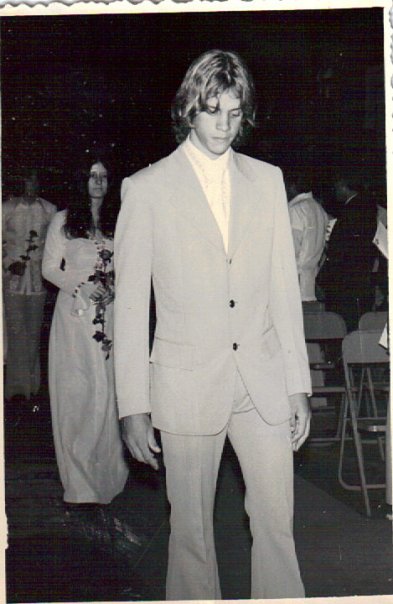
The night of the Prom, Dana and I walked up to Hamilton Hall to pick up our dates. I presented Cindy with an orchid corsage and she gave her stamp of approval to my clothes.
All the other girls came down to admire the finery and see us off. Then it was time to go; George drove up in the school's VW "Combi", he would be taking us over to the Main Club at Camp John Hay. The dinner was a wonderful formal affair, afterwards we all got up en masse to dance. Making sure we were on the floor for every "slow" dance, I finally got to get my arms around Cindy. Oh, what a night.

Two days later and I watched as some of my closest friends marched down the aisle and up on to the stage. As president of the Junior class, Jaime lead the way, the graduating seniors in procession behind him. It was a somber moment as Pomp and Circumstance swelled. A time for endings, a time for beginnings. The Seniors choked their way through a song by Seals & Crofts, We May Never Pass This Way Again. Afterwards, lots of hugging, lots of tears.

After graduation that night we went to a party being held off campus at the home of one of the graduates. Honestly, I can't tell you a lot about the party. Most of the seniors were there, there was lots of food; I remember there was chocolate cake and cases of Cold Duck. Lots of cases. Turned up loud on the stereo was Paul McCartney and the Wings new album Band on the Run. We all seemed to know the words to every song and when Picasso's Last Words came on we lustily joined in.
" Drink to me, drink to my health, you know I can't drink anymore"

Well, we sure could and we did. Cases. We were still up when the sun rose the next morning and a bleary eyed Mr Pettitt drove those of us who had to catch a plane to Manila back to Brent to pick up our luggage. He was still suffering from the previous nights over indulgence and we came close several times to running off the road or into a tree. As we weaved back and forth across the yellow line, I made a mental note to add
Cold Duck right next to Ginebra San Miguel on my list of alcoholic beverages I would never drink again.

Sunday, January 16, 2011

Part 44: Ride the High Country

Since the very beginning of Bishop Brent's Baguio School, outdoor excursions were an integral part of the curriculum. Santo Tomas, Asin Hot Springs and trips to the beach were regular parts of student life. On February 28, 1910, the first annual Great Northern Hike up into the mountains of the Cordilleras was undertaken. For the first few decades the entire school would take part in this adventure. Headmaster, teachers, students, the cook leading a pack mule loaded with pots, pans and supplies would head north on foot. On occasion even Bishop Brent would make the 250 mile trek; from Baguio up 2000 feet to Haight's Place, on to Suyoc, Cervantes, Sagada, Bontoc and finally Banaue and then back to Baguio.

After the school went co-ed in 1926, it was deemed to be unladylike for the girls to take part in the annual hike. Post WWII the Great Northern Hike had become a class activity, limited to those who signed up to go, usually Seniors and Juniors and now they went by van, bus or truck.

So it was that I found myself part of Mr Pettitt's field trip into the Mountain Province. We were to collect field research and write a term paper that would count as 25% of our final grade. Norman, Curby, CJ, Scott Jazynka and Lulie were just some of students who had signed up. We loaded up a truck with our gear and supplies, gym mats on the truck bed and a tarp over the back half to keep them dry and give those of us riding in the back a little shade. Canvas straps were woven between the end posts to keep us from bouncing out on the rough narrow mountain roads. The chaperones took turns riding up in the cab which was not as much a luxury as you might think.
The roads were very narrow, at times one side of the truck would scrape the cliff walls while on the other the outside tires hugged the edge of the road. It was much more scary being inside the truck than in back where we could only see the road behind us.

Our driver was George Latawan, a mountain man who wore cowboy boots, a cowboy hat and US Army surplus coat. He drove fast in Baguio and drove faster on the open mountain roads. I don't think Pettitt or the other teachers on our trip knew it, but George always kept a bottle of Ginebra San Miguel behind the seat of the truck. Now that he was away from the school he was able to partake of his favorite beverage from time to time. Ginebra was very popular among the mountain tribes. We would pass villages where mounds of empty bottles were stored in fish nets, waiting to be taken down the mountain to be sterilized and refilled. The youngest member on this field trip, I got the
distinct feeling that quite a few of them didn't like having an underclassmen along on the trip. Some of them complained to Pettitt but he had already made up his mind. So I spent my free time hanging out with George. I helped him each morning to get the truck loaded and ready to go; I became his "sidekick" during this trip.

We spent most of the first day driving, it was hot and dusty in the back of the truck and after a few hours we got used to the amazing scenery around us. But then the fog started rolling in, so thick now that we could only see the road thirty feet or so ahead or behind. Here and there the tops of the tall Benguet Pines poked out and then rock formations, looking like ghostly towers or parapets of castles appeared! Sagada. Home of famed anthropologist William Henry Scott. Clean, pristine, pine forests right up into the town; white and green houses and buildings that looked like Brent. The old church looked medieval which added to the mysterious atmosphere. Sagada was the second largest Episcopal mission in Mountain Province, older than the one in Baguio. Long before Bishop Brent opened his school, Fr. Staunton, another Episcopalian legend was at work in Sagada. He started schools, a lumber mill, acquired a printing press; later a convent was opened.

Dirty and tired we hurried up to unload the truck because it looked like it was going to rain; we were going to sleep in classrooms of one of the schools. Later, when it started to pour, Lulie and I grabbed our soap and shampoo and went out to shower under the downspout. It was wonderful to get the grime of the road off our bodies. Afterwards, we started work on supper. George went up to Mr Pettitt and asked " I need to go into town to pick up some supplies, can I take one of the boys to help me?" That meant me. We left and George made a beeline straight to a local watering hole. He bellied up to the bar and ordered gin with a water chaser and a beer for me. The bartender poured a tall water glass full of Gin and the same size glass with water in it. George drained the Gin and then chugged the water. Mouth open, I stared at him in horror, my stomach burning, beer halfway to my lips. Yikes! He had another, this time drinking it much slower while I drank my beer. Refreshed, we headed back to the school. This would be our routine when we hit a town. Gin for George, Beer for me.

That night as part of our class assignment, a village elder came and told us the old legends of his tribe, of their gods and how his people came to be. George was our interpreter, interjecting his own comments from time to time. The old man told us a story of how the luck of the village had changed when their sacred tree had been cut down. Many years before a group of young men came from a rival village and cut down their tree in retaliation for cutting down that village's sacred tree.
Things went from good to bad to worse for the village after that. As we sat around the fire listening to the old man's story George turned to me gleefully and whispered "I was one of the young men who snuck into the village and cut down the tree! Better to cut down a tree than to cut off each others heads!"

The next day we pulled out, headed to the next town. At the next village the local shaman came to read chicken entrails. Apparently you foretell the future by looking at chicken guts. I got delegated to hold the live chicken while it's wings and body were beaten with a stick, something to do with forcing the blood to certain parts of the body. That's me being totally disgusted. Each village was different than the other, not only did the locals dress differently, but the architecture of the homes changed too. It was amazing that from one side of the mountain to the next things could be so different. We were to find that Sagada was an anomaly among the other towns we visited, cleaner, friendlier and more familiar to our Western eyes and tastes. We stayed dirty for days, stopping once at a river to wash. By this time neither the boys or the girls cared about bathing in their underwear, we just wanted to get clean.

The last stop on trip was Banaue, famous for the impressive views of the rice terraces. This time we would be spending the night at a hotel there, overlooking the famed rice terraces. We would have the use of our own beds with clean sheets, flushing toilets, showers and a swimming pool. Heaven. A few hours later, washed, a full stomach we were lazily lounging in the pool watching a single engine plane come up the valley. Thirty minutes later there was a commotion by the bar, and one of my schoolmates came hurrying up. "hey that plane we saw, it crashed! They say some Americans are hurt!"
Some local farmers had seen the plane crash and had stopped a passing car to send word to get help. We threw on our clothes and ran out into the parking lot where a truck was getting ready to pull out. We climbed aboard and away we went. We drove a few miles and pulled up next to another truck stopped by the side of the road. There was a heated conversation going on between the local police, the farmers and the occupants of the other vehicle. Apparently the occupants were dead, they were Americans and being apprehensive about handling dead bodies no one wanted to touch them. "They have sent for the PC, they are worried about the dead spirits" someone said. Crude stretchers had been made from branches and blankets by the farmers. Norman and some of the guys grabbed stretchers and headed over the side of the road and I followed. We got to the plane and they were in fact dead and we were going to have to get them out of the plane and back up the mountain. I avoided looking at their faces. Where the seat belts were their clothes were torn and the bones badly broken. They were so heavy. I wondered how their shoes got off their feet. All of a sudden I wasn't so sure I wanted to do this. Fortunately for me there were twice as many Brent students as were needed. Norman took charge and in short order had the bodies out, strapped on the stretchers and mostly covered in blankets. As they filed past me I involuntarily looked at the foot of one of the bodies, it was grayish blue. I found myself wondering at how fast life leaves us; in a short hour the things that mark us as alive are gone. As we made our way back up we passed soldiers climbing down. The PC had arrived.

After we got back to the hotel we had a meeting over drinks, I know I needed one. We were supposed to spend another day there, but no one felt like hanging out. We took a vote and it was decided that we would head back to Brent in the morning. I went to bed early that night, though some Seniors were tempted by the hotel bar.

It was fairly quiet in the back of the truck for the first few hours, each of us lost in our own thoughts. Scott, Curby and I were leaning up against the straps at the end of the truck. It was a little tricky, keeping your balance and leaning back without bouncing out of the back of the truck, but we managed to get the hang of it. One of the girls turned on her cassette player and all of a sudden we were singing along to ABBA and then the three of us did an impromptu dance number to a new song by The Three Degrees called "When Will I see you Again", singing at the top of our lungs. Life goes on
.

Saturday, January 1, 2011

Part 43: Whistle Down the Wind

"People forget that when you’re 16,
you’re probably more serious than you’ll ever be again."
- John Hughes


In December of 1974 I turned 16 and I was terribly serious (when I wasn't being goofy). This generally was an impediment, girls like boys who are not so serious or too goofy. It was hard deciding on one or the other and the middle of the road seemed kind of blase. The Seniors were cool and seemed so mature, they were on their way to change the world and I, well sometimes I still wanted to be a kid.

Being a kid meant playing Frisbee or Red Rover on the Neutral and Capture the Flag in the Valley. It also meant doing the duck walk down Session Road arm in arm with my favorite girls. It meant sneaking into Paul Bowman's room every night to turn his electric blanket on high, then waiting for him to wake up screaming. Or helping my buddies Mike Kendrick and Tom Lowman build a secret hideout in the ceiling above our rooms. We opened up the recessed florescent ceiling lights to make a hatchway up into the attic of our dorm. We drug up a couple of mattresses and some throw pillows from the lounge and Tommy wired it up for lights and a fan.
Tommy was a fun guy to hang out with, he loved The Beatles, martial arts, scuba diving and was something of a genius. The hideout didn't get much use, after all we had the entire campus to hang out in, but it gave us something to do.

Mr Pettitt was directing a play called Henry IV. No, not the one by Shakespeare, the one by Luigi Pirandello. It is an examination of the fine line between sanity and insanity. A wealthy man falls off his horse during a historical reenactment and wakes up thinking he is Henry IV of Germany. A lot of the characters had pages of dialog, Jaime
was playing the title character and had a speech that was 3 pages long. We were all struggling to memorize so many lines, and Pettitt was getting really impatient during our rehearsals. He got fed up one day and issued an ultimatum: have all your lines memorized by next week or the play is off. We practiced hard, each of us helping the other work on their lines when ever we had a free moment. Finally, just a few days before the deadline we thought we had done it. Well, most of us did. A few were still having trouble. I had been working with Jaime and Kevin and they finally had it down. The rehearsal came and we went through our lines and a few made some minor mistakes but not too bad. But then Kevin did his part and forgot a few words of his last speech. That was it. I had worked with Kevin in Murder in the Cathedral and knew he could get it down, but Pettitt was like my dad and had no patience.
Pettitt said "it's off".
For days we tried to reason with him but he wouldn't budge. Months of hard work down the drain. Some of the cast were pissed at Kevin, most were mad at Pettitt for being such a hard ass.

A few months later some of us found it rather annoying that Mr Pettitt took a part in the play Oklahoma! Jaime was still pissed and didn't even try out.
It was a big production, it seemed like most of the school was involved one way or the other in the play. Mrs. Tabafunda was real busy sewing costumes for everyone and Mrs. Villaba had her hands full as music director. Some of the roles had multiple actors which made rehearsals complicated and confusing. Leigh & Leeanne got the part of Aunt Eller, Kevin & Jim Evans were Jud Fry, Cindy Johnson and Noni Donohue were Ado Annie, Dayne Florence was Ado Annie's father Andrew, Dana Busse was Curly, Beth Wagner was Laurie. I had a tiny part as one of the cowboys, but I didn't mind, it gave me plenty of time to flirt (in the dark) backstage with Marie Strasser and Margie Molina. Kevin poured himself into the role and gave a memorable performance.

Life in the dorms at Brent School was a wonderful, transformative experience. A school within a school, our education did not conclude with the last class each day. Not having parents or a family to guide me, I put into practice the archaic things I picked up from old movies and novels: a gentleman
always holds out the chair for a woman at dinner and always carries a clean handkerchief to present to a lady for those inevitable moments of tears. I learned to listen or at least to pick up on a stray word here or there, a look on the face. In spite of and because of my limited budget I learned to give thoughtful, insightful gifts.

We were a diverse lot, we all came from different social and economic backgrounds. We didn't watch much TV after school or at night, we usually sat on the student lounge steps and talked about the books we were reading and what was going on in the world.

Nixon had resigned, Ford took his place and in February we were let out of class to watch TV as a large group of recently released POWs arrived at Clark Air Force Base. Music was changing too. Something called "Disco" was infiltrating the airwaves. The times they were a changin'.

We didn't always agree and many a heated debate that started on the steps of the student lounge would carry on into the dining room, sometimes afterwards they would carry on late into the night back at the dorm. But in spite of it all, in some strange way, we were bonded together.

In a discussion about empathy, Rug once said that it was all relative. Everyone sees the same event slightly different. My worst or best experience could be minor in the eyes of someone else.
"So how can we empathize with someone if we don't experience things the same way?" a classmate asked. You first have to admit that their point of view is valid. Then you have to try and learn what experiences may have formed and shaped them into arriving at that viewpoint.

The boarding students were my surrogate family and though the boys lived in one dorm and the girls in another, most managed to form close bonds. Some were to last a lifetime, some were lost, others found again.


"Whistle down the wind, let your voices carry
Drown out all the rain, light a patch of darkness
treacherous and scary
Howl at the stars, whisper when you are sleeping
I'll be there to hold you, I'll be there to stop
the chills and all the weeping
Make it clear and strong, so the whole night long
every signal that you send, until the very end
I will not abandon you my precious friend
So try and stem the tide, then you'll raise a banner
Send a flare up in the sky, try to burn a torch
and try to build a bonfire
Every signal that you send, until the very end, I'm there
So whistle down the wind, for I have always been right there"

Monday, December 20, 2010

Part 42: Holiday Road

The holiest of all holidays are those
Kept by ourselves in silence and apart;
The secret anniversaries of the heart,
When the full river of feeling overflows;--
The happy days unclouded to their close;
The sudden joys that out of darkness start
As flames from ashes; swift desires that dart
Like swallows singing down each wind that blows!
White as the gleam of a receding sail,
White as a cloud that floats and fades in air,
White as the whitest lily on a stream,
These tender memories are;--a fairy tale
Of some enchanted land we know not where,
But lovely as a landscape in a dream.
- "Holidays" by Henry Wadsworth Longfellow

While lowlanders considered Baguio the vacation destination, we who lived in the city on the other hand usually went somewhere else for our holidays. We got about a week at Thanksgiving and another at Easter, but the longest holiday was Christmas break, lasting close to three weeks. In my first years at Brent I spent the shorter holidays in Baguio with whatever missionary families my parents could pawn me off on. Sometimes I got to spend it at Camp John Hay at a classmate's home. Later, Jaime and I more often than not spent the shorter vacations together with his family in Baguio or at his house in Solano.

I was still nursing crushes on Leeanne and Lulie, but the former had a boyfriend in a band in Manila and Lulie was dating Jaime. But we were still friends and this year we took several trips together down to the lowlands where we'd spend a long weekend at Linda Schwartzendruber's home in Forbes Park or at Lulie Lawry's home on Clark Air Force Base.

Named after William Cameron Forbes (who in 1904 at the age of 34 became the Commissioner of Commerce and Police in the Philippines; 5 years later he was appointed Governor General), Forbes Park was a gated community founded in 1940's. The wealthiest families had homes there; Manila Country Club and the Polo Club were within its boundaries.

Besides the armed guards at the main gate, Linda's home had its own guards at their gate too. Situated right next to the Polo stables, I could see the riders practicing from the upstairs window. The house was enormous, the entry more like a hotel lobby, with a Chinese Rickshaw from Hong Kong under the curved stairway, an antique elephant chair from India and a huge Siberian Tiger skin on the floor. Our whole house in Tacloban could fit into the living room area (really a series of 5 living rooms)! The large dining room was circular and the table in it was too. and there were three kitchens back to back. Despite all the trappings that surrounded them, the Schwartzendrubers were a warm and down to earth couple. He was tall, looked kind of like Cary Grant but spoke more like Gregory Peck. She was dark haired and petite, she reminded me of Harriet Nelson from The Adventures of Ozzie and Harriet.

When we went to Manila we would stop and pick up a dozen roses to bring to Mrs. Schwartzendruber. Our afternoons were spent shopping in Makati, sometimes we would catch a movie at the Rizal Theater. Leeanne and I saw Young Frankenstein and Earthquake there. In the evenings we'd meet up with other Brent students, congregating together at someplace like Italian Village or Shakey's for pizza and beer. Afterwards, we might go to a schoolmate's home. A few times it was back to Linda's home to swim in her pool, play billiards and take advantage of one of the many fully stocked bars.

Going to Clark was a totally different experience. It was like being stateside, albeit a tropical U.S.A. American cars and trucks, stores and shops, even the neighborhoods looked American.

Founded in 1902 as a US Cavalry post called Fort Stotsenburg, it originally was home of the 26th Cavalry and the 86th and 88th Field Artillery regiments. Eventually the Army Air Corps established an airfield there and Clark Field was born. A bustling air base at the height of the Vietnam War, Clark Air Base was at that time the largest overseas U.S. Military base in the world, covering 156,204 acres. While in the early days most of it was uncultivated grasslands and jungle, the base grew up and around the old army post, a small city surrounded by tall, magnificent trees. The 13th Air Force Headquarters occupied buildings that went back to the early 1900's. The base was an odd mix of American Colonial bungalows and modern track housing.
The Officers' Club surrounded by the graceful old homes with large verandas, was a stark contrast to the modern rectangular block housing of the single enlisted men. There were shopping centers, bowling alleys, movie theaters, restaurants, clubs and schools. In the late 60's and early 70's there were around 8,000 American kids in the base's school system.

Lulie's mother Chloe met us in front of the house with hugs and kisses. A beautiful southern belle, she took a real shine to me and showered me with attention, which kind of annoyed Jaime because he was Lulie's boyfriend after all. But maybe she knew I was the odd man out and was compensating for the agony I was going through. She took me by the elbow and walked me into the house, completely ignoring Jaime. She asked me what I'd like to eat while I was there, she would fix whatever I was hungry for. So we had roast beef, ham, turkey and mashed potatoes, hamburgers and steaks, German chocolate cake, pecan and cherry pies, peach cobbler and ice cream. I was in 7th Heaven. On my second visit to their home she met me at the door with a big pitcher of screwdrivers calling out "Marky, look what I've got!".

One night well after midnight we were sitting around listening to music and talking when Lulie's dad came out in his uniform strapping his side arm to his waist and grabbing his automatic rifle from the closet. "We're on full alert. You kids stay inside till I find out what's going on" he told us. The next morning he called to say we could go outside but we had to stay on the base. Later that morning Lulie got her mom's car and we drove over to the Hobby Store to pick up some leather crafting supplies. She drove around the base to see if we could see what might be going on. The Main Gate was closed and they had big trucks blocking the entrance. The fighter jets were out of the hangers and they were all being armed. Base security trucks with .50 caliber machine guns in the back were driving the perimeter and even patrolling through the residential areas. Lulie and I were out sunning ourselves in the drive way when a jeep drove by slowing down to see if we were OK. It was pretty exciting but I never did find out what was going on.

It was at Clark that I had my first taste of good Irish Whiskey. One night Lulie's parents were having a dinner party for some of their friends and we were helping out in the kitchen. After the meal, it was time for coffee and dessert and Lulie's mom was making Irish Coffee. She carried a tray of cups into the living room but soon returned bearing a single mug. "Mark, taste this, it doesn't seem quite right." It looked delicious, whipped cream floating there with a sprinkle of nutmeg on top. I took a big swallow and choked, my eyes watering, the liquid burning it's way down my throat and into my stomach.
"Uhmm, There's no coffee in it" I sputtered and coughed, Jaime pounding my back.
"Whoops! I knew I forgot something!"

We went to the movies, sometimes to the Bobbit, other times to the Collin Kelly. One weekend we went over to the high school football field called the Bamboo Bowl, to see Steve McQueen and Dustin Hoffman in "Papillon". We sat on the field watching the movie; I was painfully aware of the couple snuggling on the blanket next to me and vainly tried to ignore them. But they were in love and their happiness and contentedness spilled over, enveloping me in the warmth.


Thursday, November 18, 2010

Part 41: The Tempest

"These our actors, as I foretold you, were all spirits and are melted into air, into thin air... We are such stuff as dreams are made on and our little life is rounded with sleep."
from The Tempest by William Shakespeare


I'm sure there were school activities those first few months of school, some field trips maybe; my friends Leigh, Lulie and Leeanne had lead roles in Alice in Wonderland, but I can't really tell you much about the first part of the semester, because I was preoccupied, I had a girlfriend. For some reason it seemed to take up all my free time and I was neglecting my friends. I think they were sort of happy for me although they often appeared concerned. OK, so things got a little tempestuous at times. It was turning out to be an on again off again relationship. We would break up and then a few days or a week or two later we would get back together again. Things would be great at first, but then they would slowly start to fall apart and neither of us seemed to know why.

Mirroring my life, the 1974 Typhoon Season was a busy one, there were 35 typhoons or tropical storms between January and December that year. Not all the storms impacted the mountain provinces, but we had more than our share. Baguio had an early warning system, a siren located near City Hall which could be clearly heard around the city.
It consisted of a single or a series of siren wails; the Mayor would determine the number of signals depending on what the weather bureau (PAGASA) would announce:

Typhoon Signal #1 - some elementary schools had the option NOT to go to school, or if during the day, have parents pick them up.

Typhoon Signal #2 - elementary and high school kids go home, universities and government still at work. Heavy rain coming within the next 4 to 8 hours.

Typhoon Signal #3 - no work, no nothing, get home. Emergency/disaster groups and utilities get ready. Heavy rain, strong winds expected within the next 4 hours.

Typhoon Signal #4 - Typhoon is here, don't go out, very dangerous conditions.

Brent didn't recognize the first two signals, it was only when the third signal would commence that school would be let out. I never actually heard #4, by then the wind and rain were so strong that the sirens could not be heard.

There were a few minor storms and typhoons the first few months of school, but nothing that caused the school to close. This all changed when Typhoon
Susang hit Baguio one Thursday afternoon in October. I was in English class when we heard the first siren go off, no big deal we heard these often enough; then the second siren sounded and we all sat there pretending to be paying attention while listening with a cocked ear for the third siren. There it was! School was out! Susang struck Baguio on the 10th of October, bringing 30.8 inches of rain in less than 24 hours. A week later and we heard the sirens again, waiting with baited breath for that third siren. That typhoon was Tering and it was followed by Uding 6 days later. This was getting kind of old, it seemed my clothes were always damp. Typhoon Wening hit four days after that. On the first of November, Yaning blew through and Aning hit us a week after that. Each time now you could hear the classes around Ogilby counting out the sirens: one... two... three! The roar of cheers and the boarders would go running back to the dorms to fill the wood boxes with firewood, then to the canteen to stock up on snacks. The rain would start, then came the winds, eventually the power would go out; usually shut down by the power company to avoid injuries. We ate dinner by candlelight, later that night two raincoat clad houseboys would show up, one bearing a petromax lantern in one hand and a thermos of coffee and another of hot chocolate in the other; the other houseboy gingerly carried the inevitable tray of jelly rolls (we had the same snack every night for five years!).

Weekends during these typhoons were spent at Hamilton Hall (although the girls did surprise us a few times by showing up at the boys dorm), playing cards, eating snacks and listening to someone play the guitar while singing along. We would make the trek up the hill, leaning into the wind and by the time we arrived we would be completely soaked. There was always a roaring fire going and the girls would give us clothes to change into; we would line up our shoes on the hearth, hang our socks, shirts and jeans over the fireplace screen and watch the steam rise from our drying clothes.

Late one night during a typhoon we got a call from Hamilton Hall, Mr Pettitt needed some help boarding up a window that had broken in the storm. Jaime and I went over and on the way we picked up a piece of corrugated roofing that had come off the covered walkway. It was really tough trying to hang on to that tin sheet in the strong wind! When we got there we carried it up to the "4 L's" sala and helped Mr. Pettitt nail it over the window. While we were doing this Linda went to use the restroom, but came out a few minutes later screaming! There was a rat in the toilet! When she went to flush she noticed something wet and furry looking up at her from the bowl! Jaime grabbed the fireplace poker and I the tongs and while I held it down Jaime killed it! I was totally disgusted. From that day forward I always look in the toilet first...

Jaime and I were still in our sopping wet clothes, so the girls offered the use of their blazing fire to dry them out. We took off our clothes and I eventually found myself trying to get warm, huddled under a blanket with a pretty classmate in her room. How I got there or where the dorm master was I couldn't tell you. I was vaguely aware that we were both in our underwear (I can't tell you why she was because I never asked), but it never occurred to me that this might be an opportunity for hanky panky! Or at least it didn't occur to me till the next day when Jaime said something about it!

After
Typhoon Aning we had a break in the weather and Mr Asiatico decided he had better take advantage of the situation and make his annual trip to 100 Islands. We got to the coast and it was still a bit overcast and the water was choppy as we headed out to sea. About half way out we heard a shout from the bow and Mr Asiatico was pointing out to a pair of dorsal fins a hundred feet or so from our boat! This was the first time I had seen sharks other than the dead ones brought in by fishermen. Two of my classmates and fellow boarders, Tommy Lowman and Michael Kendrick were with me, Tommy had brought along his scuba gear and two extra pairs of swim fins and masks. He had brought along so much gear that Michael and I had to help him get it all in the boat. That first night after supper, we helped him get geared up and he tested out his new underwater flashlight. I was swimming along side using a snorkel when Tommy poked a bunch of sea cucumbers which suddenly expelled their innards! This was totally unexpected and with muffled shouts we swam quickly back to the beach. I guess they were as startled as we were!

Later that night Tommy and I snuck out to swim over to an island that was a few hundred feet from the one we were on. There had been a concrete bridge connecting the two, but Typhoon Susang had destroyed it. Now there were just the supports sticking out of the water. We were about half way there when churning waves threw us against the the busted up bridge. I felt a burning pain on my thighs where I scraped against rebar and broken concrete. We climbed on to one of the supports and Tommy shined his flashlight on my legs, they were covered in blood! He had a bad gash on his hand and we looked at each other and said
"SHARKS".
We couldn't stay there, so we once again swam as fast as we could back to shore. When we got back to camp, our classmate Marie cleaned our wounds and anointed us with iodine. Most of the scratches were not too deep, but my legs were a little stiff and sore the next morning. After breakfast we began collecting our samples and answering our worksheets. The sky was clear, it was warm and sunny and the water was calm. A couple of sea urchin fishermen showed up on a bamboo raft, they had long poles with a steel spike attached to the end. They would go along till they spotted a cluster of sea urchins, then used their poles to skewer them and bring them up. I was watching them from the edge of the water when I felt a sharp pain in the bottom of my foot. Thinking I had stepped on a thorn or a piece of glass I went up the beach and sat down in the sand to examine my foot. I was surprised to see a fish attached to my foot! I yanked it off and it left a little bloody hole in the sole. It turned out it was some small species of Remora, about 4 inches long, that used a sucker on the top of its head to hang on to sharks and would feed off the remains of whatever the shark was eating. A great specimen for our science class, but I was not happy that it had been collected at my expense.

We still had not learned our lesson about safe swimming practices because that afternoon while snorkeling alone on the backside of the island we suddenly felt ourselves in a strong current and were being pulled out to sea. After some desperate hard swimming we managed to catch hold of a coral reef. After several attempts at trying to cross the sharp antler coral barefoot, we ended up having to walk backwards in our swim fins.

Nights on the islands were a strange thing. There was no electricity, the only artificial light at night came from our camp fires and lanterns. When it was overcast it was pitch black, but when the skies were clear you could see fairly well. We kept waking up, thinking it was almost sunrise only to find out that it was one or two o'clock in the morning. On our last night I woke up knowing it must be hours till sunrise, but decided to walk down to the beach and watch the waves. I was sitting there, pondering my life, my relationship with my girlfriend that I knew was coming to a final end, when I heard someone come up behind me. I turned to look and it was a wondrous sight. Clad in a bikini, her waist length blond hair glowing silver in the starlight she came and sat close beside me, smelling of lavender and apricots and she was most beautiful. Jaime once said of her that she was the kind of girl his mother warned him about and accordingly gave her wide berth. I didn't see it, she was young and fresh, vivacious and alive. But I followed a code; I had a girlfriend back at Brent and this girl had a boyfriend there too and I felt honor bound not to break "the rules".

We didn't talk much, we shared a cigarette or two and she put her head on my shoulder. We sat and first watched the waves, then the sun rising up out of the water till we heard the voices of our waking classmates. Rising to her knees she kissed me lightly and went back to camp.

A lot has been written about living a life without regrets, but maybe you really haven't lived if you don't regret something. As I rode the bus back to Brent I know I was regretting my inaction, when my girlfriend broke up with me a few days later I really regretted it. Although mutually agreed upon, it didn't end well. Then, as if to put a final period (or maybe an exclamation point) to the end of our relationship, Typhoon Bidang slammed into
Baguio the following Thursday, the 28th of November, knocking down trees around the city and on our campus.


Wednesday, November 10, 2010

Part 40: Routines, Rituals and Traditions


As per my annual routine I returned to Baguio a week before school started. Arriving at Brent things were comfortably the same. Crossing Neutral to Binstead, I peeked in the lounge to see if anyone might be there. It was empty, but it was a friendly expectant emptiness, as if the room was waiting for us to return and bring it back to life.

Yet to say that school was unchanged from the previous year was not true. Like every other year since I started going to Brent, the 1974-75 school year brought big changes. When I got to the dorm one of the first things I discovered was that I was now on the top floor on the east side of the dorm (as a sophomore I had expected to be on the second floor again).
This was comforting in its own way, I had woken each day my first two years at Brent with the sun rise, from my high vantage point I could see the tree covered mountains in the distance. I went and collected my trunk and other belongings and then went to select mattresses for my room. My queen size from last year was no where to be found so I assumed some teacher had got to it first. After digging through a dozen or more I was able to find two kapok stuffed mattresses that were plump, firm and at the same time soft. I spent the rest of the day arranging, then rearranging my room. That night I lay in bed watching the lightning flashes on the distant mountains. It was good to be home.

The next morning I decided to take a shower and then head downtown to do some shopping. Knowing the dorm was empty I just threw my towel over my shoulder, picked up my shower kit and walked out the bathroom door only to discover another change. We had new dorm parents, the O'Neils, and there was Mrs O'Neil walking up the steps to introduce herself! Whoops! There I was doing the Full Monty! I think she was more embarrassed than I was, all she said was
"oh, my...". I skidded to a stop and did an abrupt about face (in case she wanted a rear view) and went back into the bathroom and wrapped my towel around my waist. After a few minutes I decided the coast was clear and made my way to my room to get dressed. At dinner that night she turned bright red as I was laughingly introduced to them by my former dorm mother Mrs Pettitt. The Pettitts were now dorm parents of the girls dorm. After having them as dorm parents for two years I kind of thought of Mrs Pettitt as my surrogate mom and I wasn't too sure I liked this change.

The next few days were quiet ones, I replicated my yearly routine of collecting my school books from the book store, getting a head start on my required reading, going to the library, making a trip downtown for siopao or shopping. Along with a slew of other kids, Jaime showed up the Friday before school started; he had the room across the hall from mine. Jaime and his family had just got back from short furlough in the U.S. and I was eager to hear of his adventures. One of the things he brought back was a pair of brown leather work boots which he called "shitkickers". I really liked them and so we went to town to see if we could find me a pair in the "army surplus" section of the market. This section of the market was mostly black market goods that somehow made it from the bases at Clark or Subic to the stalls of the Baguio market. There you could find American candy, cigarettes, Army, Air Force and Navy apparel. After a hour of searching I found a pair of brand new black Navy steel toed deck boots with vibram soles and they fit perfectly. Jaime picked up some brown shoe polish and a bar of saddle soap and then we headed over to the Rose Bowl for some chicken fried rice. I tell you of these mundane facts because these items became part of our routine. If we happened to be in the dorm when the dinner gong sounded, Jaime would come to collect me saying "let's go Kid" and off we would march side by side, our boots beating out the time on the pavement, then drumming on the wooden part of the sidewalk of Binstead, our feet hitting the swinging doors to the dining hall at the same moment which would burst open with a crash, a half second pause at the top of the landing, then Jaime would step to the right and I to the left,
ka thump, thump down the two steps, our grande entree!

The next day we went back into town again with Leeanne and Lulie to catch a movie and go to a used clothing store we had heard of, the forerunner of the
ukay-ukay shops that are so prevalent in Baguio today. I picked up a black cable-knit sweater and an olive green zip up jacket like the one Clint Eastwood wore in "Kelly's Heroes". At the urging of the girls Jaime and I also purchased matching pairs of striped bell bottom Levi brand hip huggers. Now we were stylin!

There were a lot of new kids in the dorms this year, Michael and Susan Kendrick from Australia, Juli Tin, Margie Geronimo, Chris Fassnacht, Donna Stackhouse, Cathy Blowers from Africa, Cindy Hill from Saigon, Marianne Salvo from Laos, Paul Bowman, James Jensen from Liberia, the Lipka brothers from Indonesia, Chuck Wheeler and Joan Barber who came from Saipan, Tommy and Mary Lowman out of Vietnam, and a bunch of Canadians, much to the delight of Leeanne Colvin. There was Dana Busse, Pierre Sabourin, Garth Patterson, Cindy and Kelly Low. Garth came to the dorms with his hockey sticks, I am not sure where he thought he would be playing. I think this was our most culturally diverse year, with the Canadians, four British kids, three Australians added to our normal Filipino and American mix.
The Brent student population really swelled that year, my class which in previous years bounced between 11 and 14 students, now numbered 22. Besides the high school students we also had that year for the first (and last) time Junior College students!

The first few weeks went by quickly, class and student council elections; the new Senior class president Norman Van Vactor quickly gaining huge popularity by securing Rug's old room off the dining hall as a private "Seniors Only" lounge. With all these new students, the annual Senior class fundraiser "Slave Day" was a huge success. The auction which normally ran about 30 to 40 minutes from beginning to end, dragged out to an hour and half. Relationships seemed to form quickly that year too, by the time Slave Day rolled around most of the "available" girls had boyfriends. Somehow I found myself with a girlfriend too.


Rituals. We all have them, the little things we do when we get up in the morning, when we go to bed at night. Humans are creatures of habit, we tend to like doing things in a certain order, step by step instructions, bullet points, map directions, the laundry lists of our lives. There is comfort in the sequence, a sense of accomplishment after completing a step. It is an unspoken acknowledgment: we can't control what is happening out there but we can control this. For some of us it is something more. The ritual of my annual return to Baguio and Brent is something I have written about many times; I am writing about it again to emphasize how much it meant to me. I could leave Baguio any way I liked, plane, car or bus. But I had to return exactly the same way each time now. I think subconsciously I was afraid to break my routine, as if it might jinx my new life. So I followed my routine: plane to Manila, taxi to the PNR bus station, bus to Baguio, closing my eyes and waiting for the scent of pine and the coolness on my cheek before opening them again. But there was something else I haven't mentioned before. When I stepped off the bus I experienced this emotional release; like the sensation a child experiences when they think they are lost and beginning to panic when suddenly they catch sight of their parents: the heart drops to the pit of the stomach and rebounds equally fast, pulling with it all the pent up fear and agony, the hiccup before the torrent of tears comes exploding forth with relief at being safe again. This is what I felt each time I returned, this is how much it meant to me.

"I'm back" I would silently whisper, wrapped in their warm embrace.

"... And like he told me, when she holds me, she enfolds me in her world."
from the song "Corey's Coming" by Harry Chapin